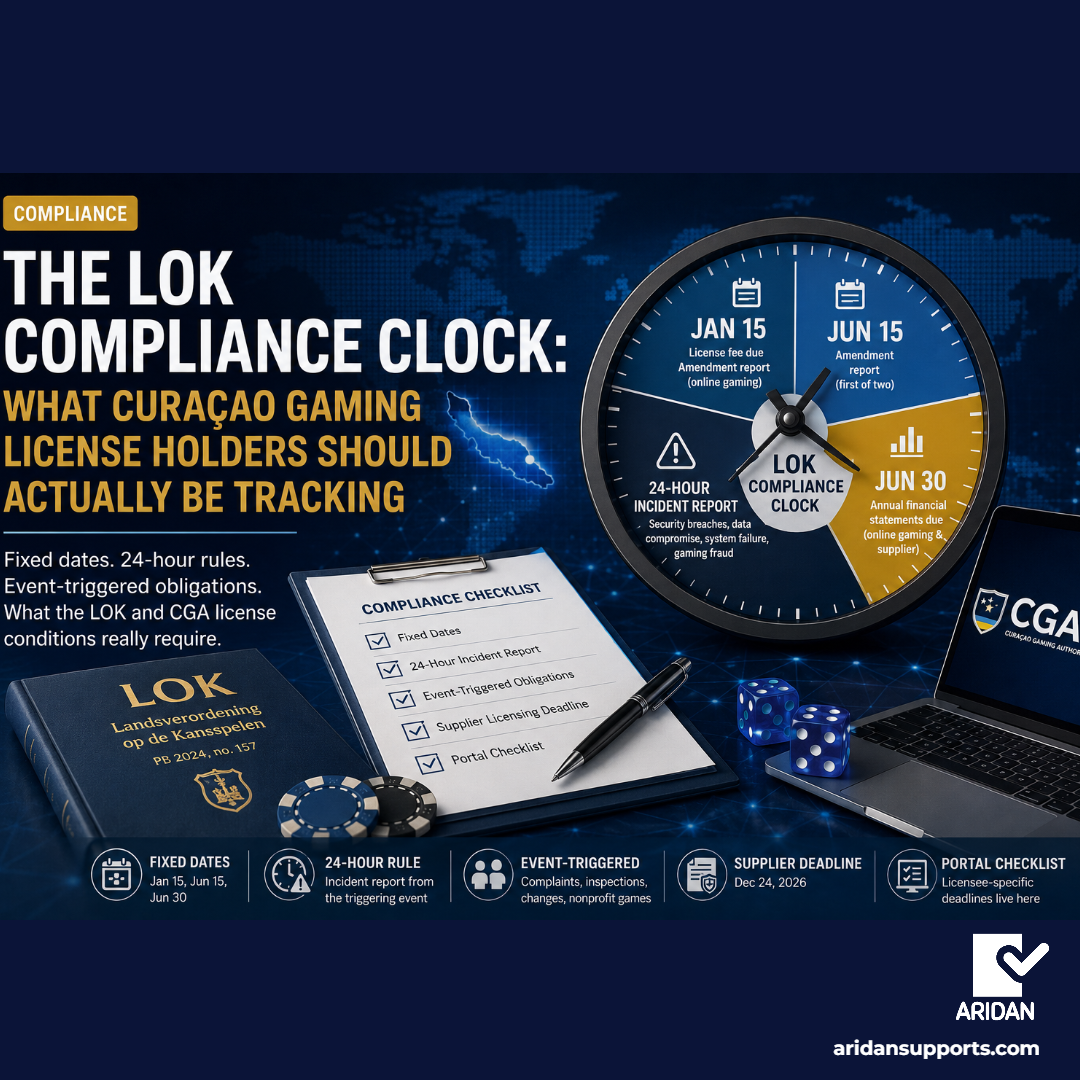
What Curaçao gaming license holders should actually be tracking.
Curaçao’s gaming sector has spent the past two years absorbing a genuine legal overhaul. The Landsverordening op de Kansspelen (LOK), the National Ordinance on Games of Chance, PB 2024, no. 157, replaced the old offshore-hazard-games regime and handed the Curaçao Gaming Authority (CGA) a broader, more structured supervisory mandate. For license holders, that overhaul didn’t just change who regulates them. It changed what they owe, and when.
Much of what circulates about CGA deadlines is secondhand summary rather than the primary text. Below is what the actual texts, the LOK itself and the CGA’s own standard license conditions, say about recurring compliance obligations, and where the picture is still incomplete.
THE FIXED DATES
Two obligations land on the same calendar date every year, regardless of license type:
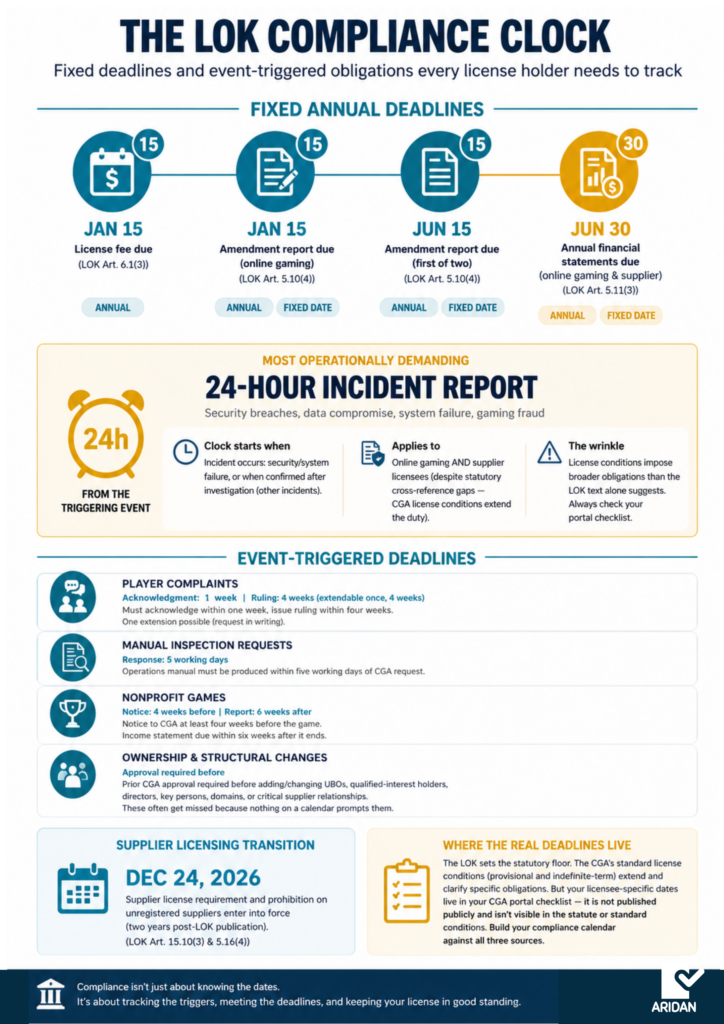
- 15 January — the annual license fee falls due (LOK Art. 6.1(3)), and for online gaming license holders, the second of two annual amendment reports on the operations manual is due (LOK Art. 5.10(4)).
15 June — the first of the two annual amendment reports on the operations manual (same obligation as 15 January, just the earlier of the two filing dates).
30 June — annual financial statements are due to the CGA, for both online gaming and supplier license holders (LOK Art. 5.11(3)).
That’s the entire fixed-date backbone of the statute. Nearly everything else is event-triggered rather than calendar-triggered, which is where most compliance calendars built from memory or secondhand summaries tend to go wrong.
THE 24-HOUR RULE, AND A WRINKLE WORTH KNOWING
The single most operationally demanding deadline in the regime is the incident report: 24 hours from the triggering event (LOK Art. 5.10(6)). Security breaches, data compromise, system failure, and gaming-related fraud all fall under it.
Here’s the wrinkle. Read narrowly, the LOK’s own text only extends this 24-hour duty to online gaming license holders; the statutory cross-reference for supplier licenses (Art. 5.13(2)) cites Article 5.10 paragraphs 1, 2, 8, and 9, and conspicuously not paragraphs 5 and 6, which contain the incident-reporting rule.
But the CGA’s actual license conditions close that gap. Both the provisional and indefinite-term supplier license conditions impose a 24-hour incident reporting requirement directly, independent of the statutory analogy clause (Art. 9(3) of each document). In other words: the license conditions the CGA actually issues are broader than a literal reading of the ordinance’s cross-references would suggest. Anyone building a compliance framework off the LOK text alone, without also pulling the license conditions, would understate a supplier’s obligations here.
The license conditions add a second nuance that the statute doesn’t mention: if a reasonable investigation is needed to confirm that an incident occurred, the 24-hour clock starts once that’s confirmed, except for security-breach and system-failure incidents, where the clock always starts at the moment the incident occurs, confirmed or not.
WHAT’S EVENT-TRIGGERED, NOT DATE-TRIGGERED
Player complaints: acknowledgment within one week, a ruling within four weeks (extendable once, by four weeks, in writing).
Manual inspection requests: the operations manual must be produced within five working days of a CGA request.
Nonprofit games: notice to the CGA at least four weeks before the game, and an income statement within six weeks after it ends.
Ownership and structural changes: prior CGA approval is required before adding or changing UBOs, qualified-interest holders, directors, or key persons, before adding or removing domains, or before entering a relationship with a critical supplier. These aren’t deadline items in the usual sense, but they’re the ones most often missed because nothing on a calendar prompts them — they’re triggered by a business decision, not a date.
THE SUPPLIER LICENSING DEADLINE, NOW ON FIRMER GROUND
One figure that’s circulated widely in industry commentary, a 24 December 2026 deadline for supplier licensing and registration, turns out to be traceable to the statute itself, not just to advisory summaries. Article 15.10(3) of the LOK provides that Article 1.5 (the supplier license requirement) and Article 5.16(4) (the prohibition on sourcing from unregistered suppliers) enter into force two years after the ordinance’s own entry into force. The LOK took effect the day after its December 2024 publication, which places that two-year mark at roughly 24 December 2026.
The CGA has since confirmed the domestic/foreign distinction directly on its own license management portal FAQ section: “Regarding the supplier license, only suppliers of gaming-related critical services and goods established in Curaçao are required to obtain a supplier license.”” (portal.cga.cw). Suppliers established outside Curaçao therefore don’t need a Curaçao supplier license, but they still need to register with the CGA if they provide critical services or goods to a licensed operator.
Industry reporting on the CGA’s guidance puts the registration window opening in October 2026, for both domestic and foreign suppliers, and recommends locally established suppliers file license applications by 1 September 2026 to allow processing time, those specific dates trace to CGA communications reported by industry outlets rather than a document we’ve located directly on cga.cw, so treat them as well-corroborated but not yet independently verified against a primary CGA text.
The obligation runs both ways. Under Article 5.16(4) of the LOK, CGA gaming license holders may not use suppliers that aren’t CGA-registered once the deadline passes on 24 December 2026, so operators, not just suppliers, have work to do before year-end: confirming the registration status of every critical vendor in their supply chain.
WHERE THE REAL DEADLINES ARE HIDING
Every version of the CGA’s license conditions, provisional and indefinite-term, for both online gaming and supplier licenses, refers to an additional “license conditions checklist” held in the licensee’s own CGA portal account, described as forming an integral part of the license itself. That checklist is where the concrete, licensee-specific dates and deliverables almost certainly live: it isn’t published anywhere public, and it isn’t visible in the ordinance or the standard license conditions.
That’s the practical takeaway for any license holder trying to build a real compliance calendar:
The LOK gives you the statutory floor, the standard license conditions extend it in specific and sometimes non-obvious ways, and the portal license conditions checklist is where the rest of it is.
This article summarizes publicly available primary sources, the LOK (PB 2024, no. 157) and the CGA’s published license condition documents, as of August 2026. It is not legal advice, and license holders should confirm their specific obligations against their own CGA portal checklist and license conditions.
Sources: The LOK (English version), cga.cw; portal.gamingcontrolcuracao.org




Leave a Reply