
What Circle’s latest USDC developments could mean for Curaçao
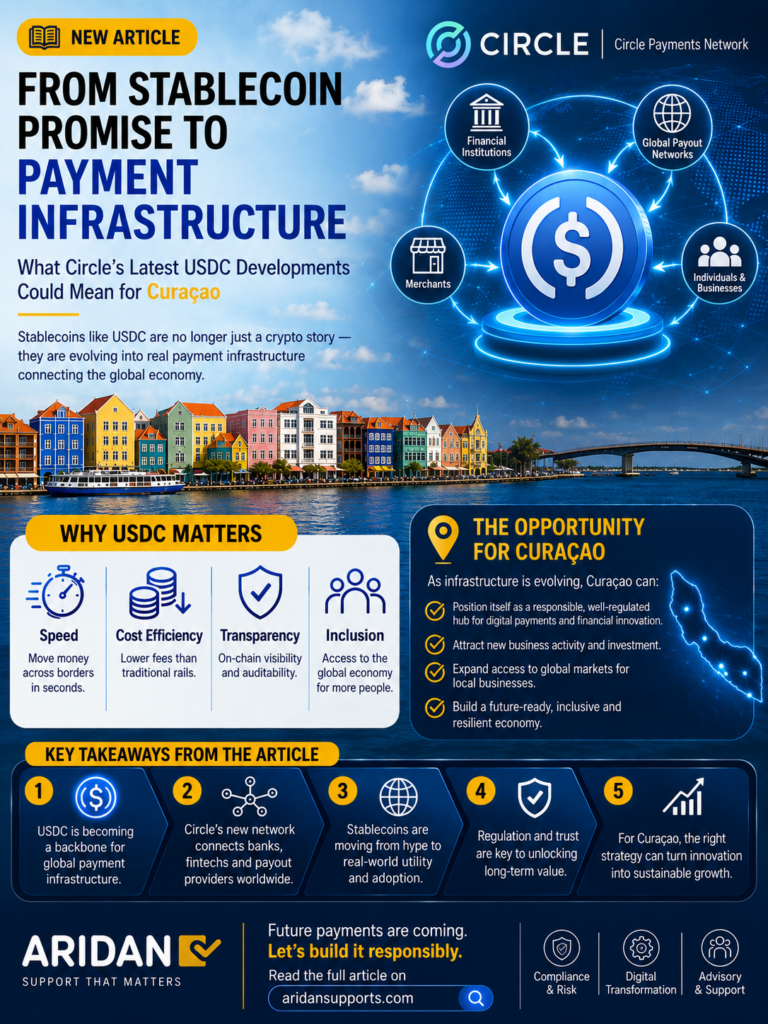
Stablecoins are moving beyond the question of whether blockchain can transfer value. The more relevant question is whether the surrounding infrastructure – banks, payout networks, regulated service providers and local conversion channels – is becoming practical enough for real-world payments.
Circle’s recent USDC developments suggest that transition is accelerating. For Curaçao, an internationally connected economy where cross-border payments and remittances matter, the development is worth watching.
USDC IS MOVING FURTHER INTO PAYMENTS
On August 5, 2026, Circle reported $73.3 billion of USDC in circulation at the end of Q2, up 19% year on year, and approximately $14.8 trillion in quarterly on-chain transaction volume, up 151%. More relevant to payments, Circle Payments Network (CPN) reached approximately $14.7 billion in annualized transaction volume and 175 enrolled financial institutions.
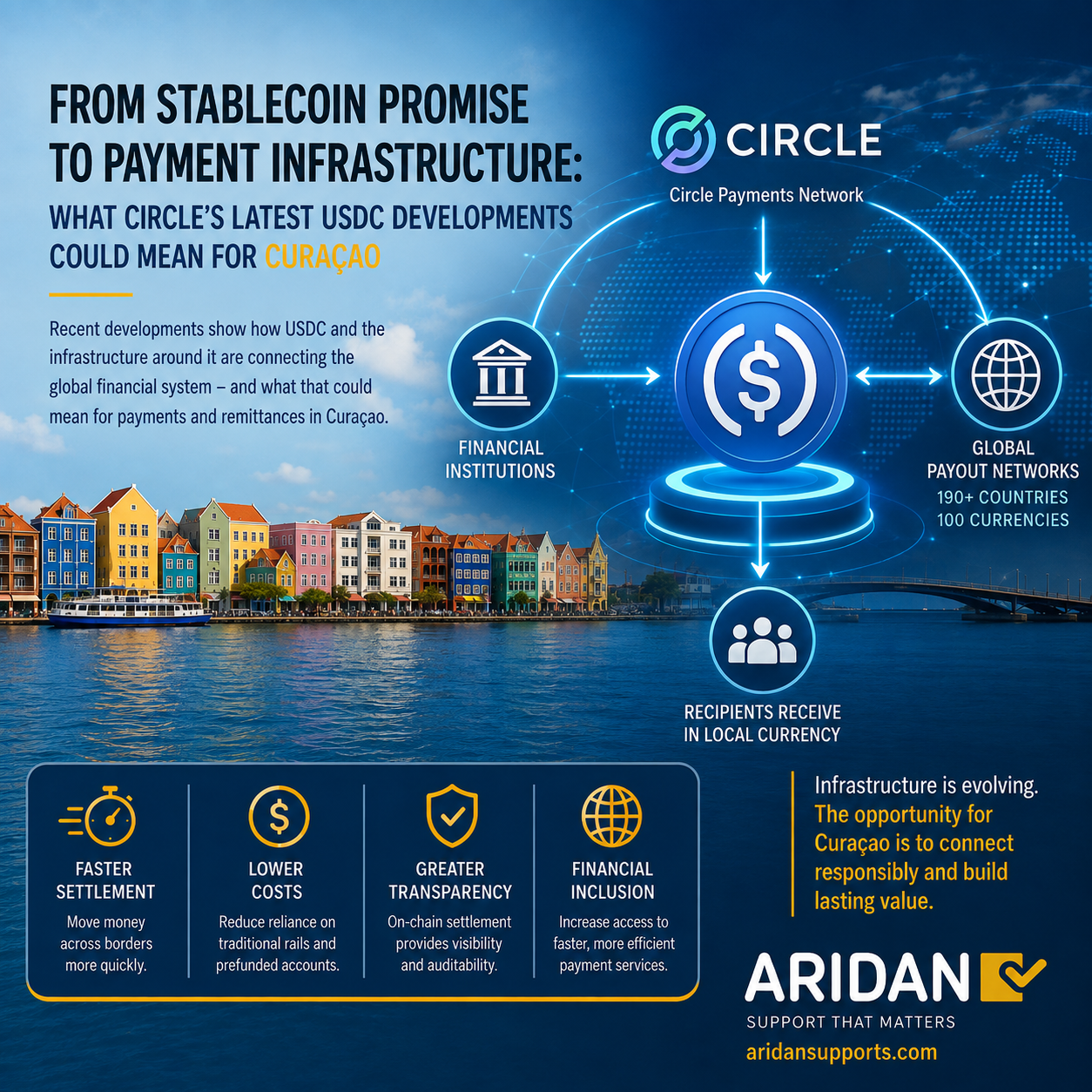
The significance is not the volume alone. CPN is intended to connect financial institutions through stablecoin-based cross-border settlement, moving USDC closer to payment infrastructure rather than simply wallet-to-wallet crypto transfers.
CONNECTING STABLECOIN SETTLEMENT TO LOCAL CURRENCY
Circle and Nium have also announced a connection between CPN and Nium’s global payout infrastructure. Nium says its network reaches more than 190 countries and supports 100 currencies. Under the arrangement, participating institutions can use USDC for settlement while the recipient can ultimately receive local currency through supported payout channels.
That distinction matters. A remittance recipient may have no interest in holding a stablecoin. The value of the technology may instead sit behind the transaction: USDC can act as a settlement rail while customers continue to send and receive familiar currencies.
BANKS ARE ENTERING THE INFRASTRUCTURE
In July 2026, Standard Chartered and Circle launched integrated USDC minting and redemption for eligible institutional clients. Initially offered through Standard Chartered in the Dubai International Financial Centre, the service connects traditional banking access with blockchain-based settlement for uses including treasury, liquidity and settlement.
The emerging model is therefore less about stablecoins replacing banks and more about banks, payment providers and blockchain infrastructure operating together.
WHY THIS MATTERS FOR CURAÇAO
In our earlier article, “Local Bitcoin Payments and Stablecoin Remittances in Curaçao: The Road Ahead,” we considered how digital assets could support local payments and international transfers. The latest USDC developments make one possible model clearer.
A future cross-border payment could, for example, be converted into USDC for settlement and converted again into the recipient’s local currency through an appropriate provider. To the customer it may look like an ordinary transfer; behind the scenes, stablecoin infrastructure could supplement parts of the traditional correspondent-banking chain.
Potential advantages include faster settlement and reduced reliance on prefunded intermediary accounts. Whether those advantages translate into lower costs or better customer outcomes will depend on the providers, liquidity, compliance requirements and transaction structure.
CURAÇAO ALREADY HAS A VASP FRAMEWORK
This discussion is not taking place in a regulatory vacuum. Curaçao adopted the Landsverordening toezicht virtuele activa dienstverleners (Ltva), P.B. 2025, no. 18, establishing a dedicated supervisory framework for virtual asset service providers (VASPs). Most of the Ltva entered into force on July 1, 2025, under P.B. 2025, no. 91.
The CBCS has stated that a VASP may not operate in or from Curaçao without the permission required under the Ltva. The precise position depends on whether the provider holds a licence, exemption or other applicable permission, including the transitional arrangements for providers that were already operating before July 1, 2025.
The existence of local VASPs is relevant because stablecoin infrastructure ultimately needs compliant points of connection between virtual assets and the local financial system. It does not, however, mean that every stablecoin payment or remittance structure is automatically permitted.
TECHNOLOGY DOES NOT EQUAL REGULATORY PERMISSION
Circle, Nium and Standard Chartered demonstrate how international stablecoin infrastructure is developing. Their activities do not determine the legal treatment of a service offered in or from Curaçao. That depends on the actual activities, the parties performing them and the applicable Curaçao legislation and CBCS requirements.
This distinction is particularly important where a model combines virtual-asset services with payment, money-transfer, custody or other regulated activities. The relevant permissions should be assessed against the specific structure before implementation.
THE ROAD AHEAD
The direction is becoming clearer: stablecoins are increasingly connecting with banks, institutional settlement networks, global payout providers and regulated local service providers. For Curaçao, the opportunity may therefore be less about creating a separate crypto payment ecosystem and more about determining how responsibly to connect to this developing infrastructure.
The building blocks are increasingly visible. The next question is how they can be used in Curaçao in a way that is commercially useful, operationally sound and consistent with the local regulatory framework.
Sources
Circle Internet Group, Inc. (2026, August 5). Circle reports second quarter 2026 results.
Circle Internet Group, Inc. (2026, May 27). Nium and Circle to connect USDC settlement with global payouts.
Circle Internet Group, Inc. (2026, July 2). Standard Chartered and Circle launch first G-SIB-led integrated access to USDC minting and redemption.
Centrale Bank van Curaçao en Sint Maarten. (2025). Landsverordening toezicht virtuele activa dienstverleners (P.B. 2025, no. 18).
Centrale Bank van Curaçao en Sint Maarten. (2025). Landsbesluit houdende inwerkingtreding van de Landsverordening toezicht virtuele activa dienstverleners (P.B. 2025, no. 91).
Centrale Bank van Curaçao en Sint Maarten. (2025, October 9). Bekendmaking verlenging meldingstermijn VASP’s.
Bitkaya B.V. (2026). Buy & sell Bitcoin, USDT and USDC in Curaçao.