
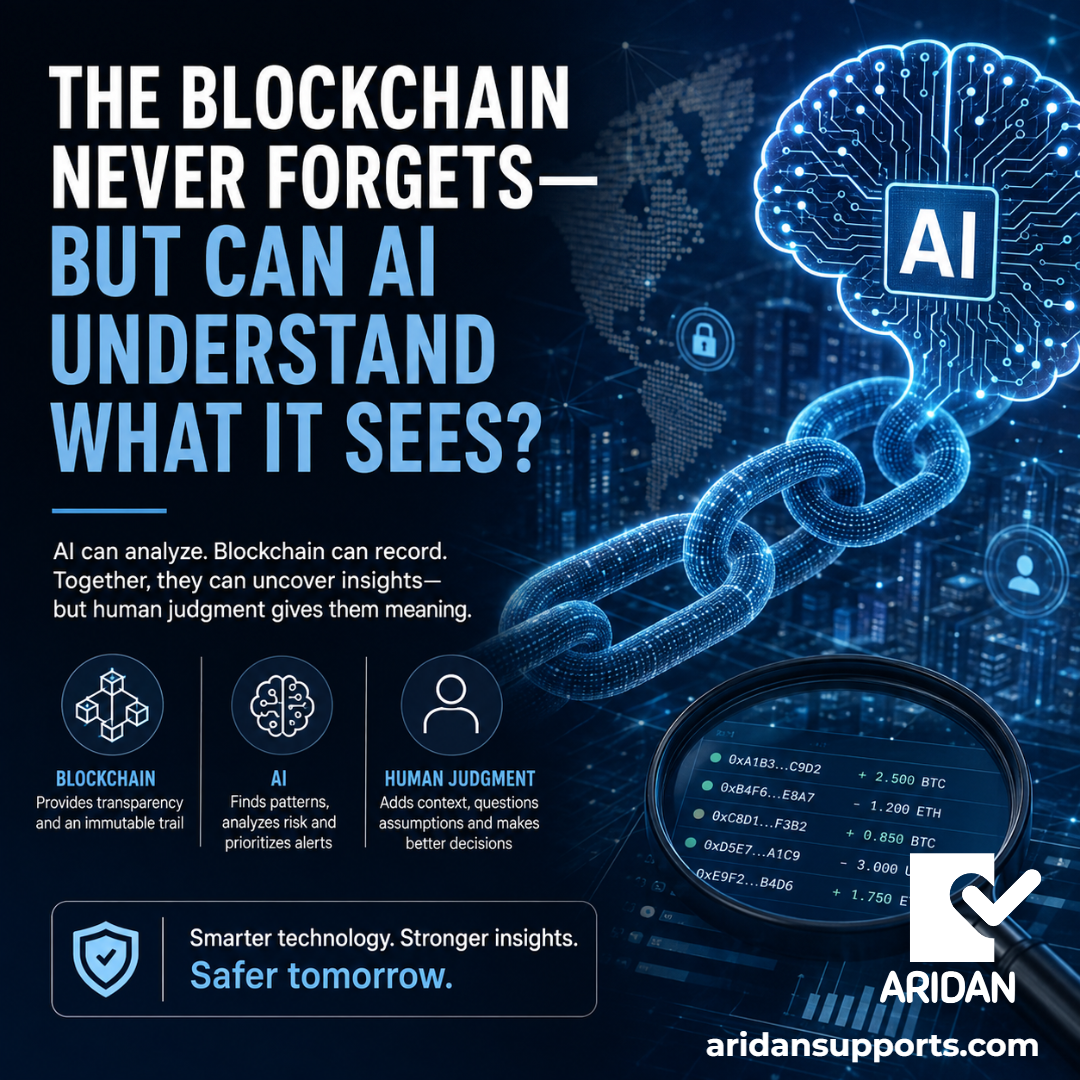
Before looking at how AI can enhance blockchain analysis, it helps to understand what blockchain actually is.
Blockchain is a digital record-keeping technology that stores transactions in a shared and largely tamper-resistant ledger. Transactions are grouped into blocks that are cryptographically linked together, creating a traceable history of activity.
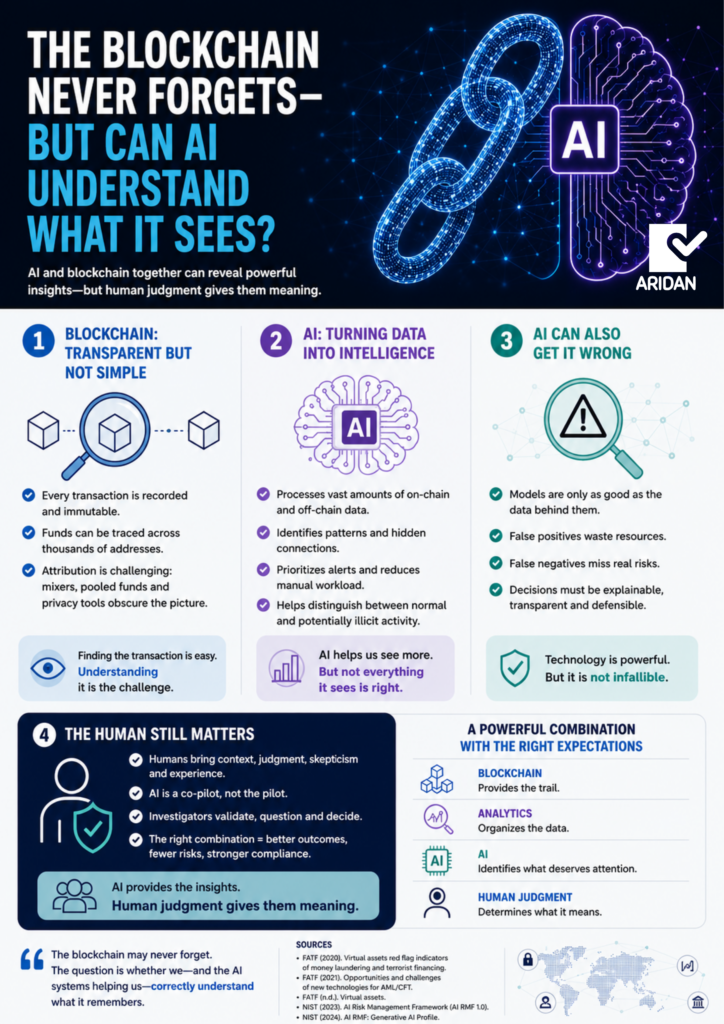
Blockchain is often described as transparent. Transactions are recorded on the ledger, funds can be followed from one address to another, and, on public blockchains, anyone with access to a blockchain explorer can inspect what happened. But transparency does not necessarily mean understanding.
A blockchain may show where money moved, but determining who is behind a wallet, why funds moved, and whether a transaction is suspicious is much more complicated. As crypto adoption grows and transaction volumes increase, making sense of all that information becomes a challenge of its own.
This is where artificial intelligence could make a significant difference.
FROM BLOCKCHAIN DATA TO INTELLIGENCE
Blockchain analytics tools already go far beyond simply displaying transactions. They can cluster addresses that appear to belong to the same entity, identify direct and indirect exposure to known risks, and combine on-chain information with external data to help investigators understand the movement of funds.
This can help identify connections to sanctions, scams, fraud, dark markets, and other higher-risk activity. FATF, for example, identifies unusual transaction patterns, anonymity-enhancing technologies, geographical risks, transaction size, and sender or recipient profiles as potential indicators that should be considered when assessing virtual-asset activity.
But blockchain analysis still has limitations. Funds may pass through thousands of addresses, centralized exchanges may pool customer assets, and mixers or other privacy-enhancing techniques can make attribution significantly more difficult.
Finding the transaction is often the easy part. Understanding what it means is harder.
WHAT HAPPENS WHEN AI ENTERS THE PICTURE?
AI can potentially take blockchain analytics another step forward.
Instead of relying mainly on fixed rules or individual risk indicators, AI can process enormous amounts of information and look for relationships that may not be immediately obvious to a human analyst.
It could help identify unusual transaction patterns, analyze networks of connected wallets, prioritize alerts, and bring together blockchain information with other available sources.
In transaction monitoring, for example, AI and machine-learning solutions can help analyze suspicious transactions, distinguish potentially illicit activity from normal activity, and reduce the amount of initial manual review. FATF has recognized the potential of these technologies to strengthen ongoing monitoring and suspicious-transaction detection.
For compliance teams facing increasing volumes of data, this could mean spending less time reviewing routine activity and more time investigating cases that genuinely require attention.
But there is an important distinction: Finding patterns is not the same as understanding them.
AI CAN ALSO GET IT WRONG
An AI system is only as reliable as the information, assumptions, and models behind it.
Blockchain attribution itself is not always certain. An address may have been incorrectly labelled. External information may be outdated. A relationship between wallets may indicate common ownership, or simply a transaction between unrelated parties.
Adding AI does not automatically remove these uncertainties.
It can potentially amplify them.
An AI system working with incomplete or inaccurate information may produce a highly convincing conclusion that is nevertheless wrong. Poorly designed models can also generate false positives, while overly permissive models may fail to identify genuinely suspicious activity.
There is another challenge: explainability.
If an AI system determines that a transaction presents a high risk, an investigator should be able to understand why.
“Because the algorithm said so” is not a sufficient basis for decisions that may affect customers, trigger investigations, or potentially lead to regulatory reporting. The NIST AI Risk Management Framework similarly emphasizes transparency, explainability, and interpretability as important characteristics of trustworthy AI.
THE HUMAN STILL MATTERS
The most useful future for AI in blockchain analysis may therefore not be replacing investigators at all.
It may be augmenting them.
AI can process information at a scale humans cannot. It can search for patterns, connect data points, and prioritize cases within seconds.
Humans bring something different: context, professional judgment, skepticism, and the ability to question whether a technically correct observation actually makes sense.
This combination is particularly important in financial crime investigations, where the same transaction pattern can have very different explanations depending on the customer, business activity and circumstances.
NIST also recognizes that human roles and responsibilities in AI-supported decision-making should be clearly defined and that AI can function as an additional input to a human decision-maker rather than replacing that decision-maker altogether.
The technology can tell us what it sees.
The investigator still needs to ask whether the conclusion makes sense.
A POWERFUL COMBINATION WITH THE RIGHT EXPECTATIONS
AI and blockchain are sometimes presented as two technologies that could fundamentally reshape finance. Combining them could certainly make financial crime detection faster and more sophisticated.
But more sophisticated technology does not automatically produce better decisions.
The real opportunity is not to remove humans from the process. It is to give them better tools.
Blockchain provides the trail. Analytics helps organize it. AI can help identify what deserves attention.
Human judgment ultimately gives that information meaning.
The blockchain may never forget.
The more important question is whether we, and the AI systems helping us, correctly understand what it remembers.
Sources
Financial Action Task Force. (2020). Virtual assets red flag indicators of money laundering and terrorist financing. FATF.
Financial Action Task Force. (2021). Opportunities and challenges of new technologies for AML/CFT. FATF.
Financial Action Task Force. (n.d.). Virtual assets. FATF.
Tabassi, E. (2023). Artificial intelligence risk management framework (AI RMF 1.0) (NIST AI 100-1). National Institute of Standards and Technology.